
There is a deafening silence that falls over a room when people realise they’ve tossed thousands of dollars down the drain, without ever knowing it was theirs to keep in the first place.
It happened about eleven minutes into our Lunch & Learn with Rachel Marston, Director at Ascot Accounting. She was explaining that if you live in a home first before renting it out, you can have it valued on the day it becomes an investment, and that valuation becomes your cost base. Every dollar of growth that happened while you lived there is wiped from the taxman’s calculation.
Lost? Let me break it down for you using Rachel’s scenario:
Brisbane median house was around $460,000 in 2014 and roughly $550,000 by early 2020. It then roughly doubled in six years, with the Cotality median dwelling value sitting at $1,104,094 at the end of July 2026.
Say you bought a Brisbane home in 2014 at $460,000, then lived there until 2020, when it was worth $550,000. Then, say that between 2020 and 2026, exactly 6 years, you rented it out. It’s now worth $1,100,000. Contrary to what you might think, you don’t have to move back in at all before selling. Under the absence rule, you can keep treating that home as your main residence for up to six years while it’s earning rent, as long as two things hold; you sell within the six years, and you don’t nominate another property you own as your main residence during that window. Do either of these things and consider the six-year rule lost.
Total gain sitting in the property: $640,000.
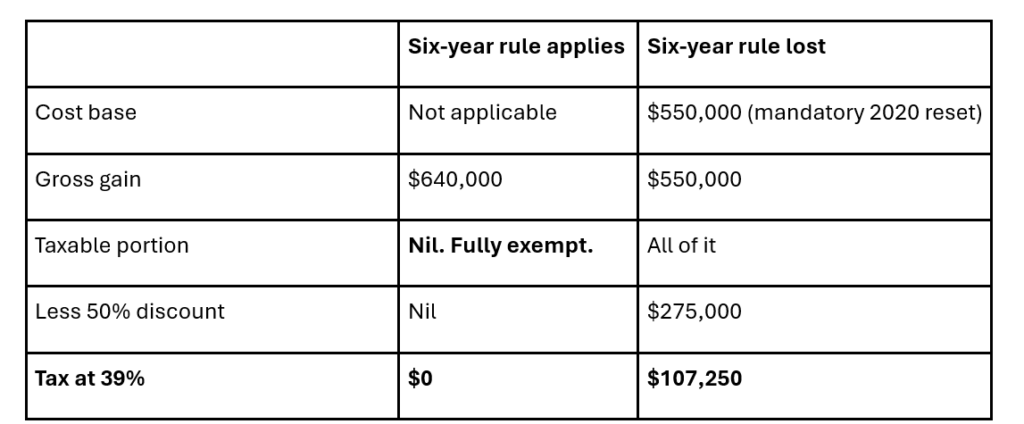
As you can see, losing access to the six-year rule would have cost you $107,250. And unfortunately, there’s no accountant clever enough to reach back through the threads of time and space to fix such an error.
Fortunately, you read this blog from Lauren Jones Buyers Agency’s Resources Page first!
That’s the thing about property tax. Most of it doesn’t come down to being smart but rather having the right sequence. Get your order of affairs right, and you can open doors you didn’t see standing right in front of you.
A word of caution: Queensland’s stamp duty home concession has its own occupancy requirement, and it is not the same test as the ATO’s. Satisfying one does not automatically satisfy the other, so its checking the requirements of both before you plan a short stay.

Moving back in after 6 years isn’t on the cards?
No worries.
Picture a woman who has lived in a house for twelve years. Most of the capital growth happened on her watch, but now she plans to buy a new home and keep this previous one as a rental.
Without a home valuation on the changeover date, the eventual capital gains tax (CGT) calculation apportions the gain across the whole ownership period. Her twelve owner-occupied years get averaged in with the rental years, and she pays tax on a slice of growth that should have been exempt.
With a valuation, the clock resets. Her cost base becomes the market value on day one of the tenancy. Everything before that is hers to keep.
Order of affairs: live in it first, then rent it, then value it. The valuation itself can be done retrospectively, so missing the appointment on changeover day isn’t fatal. A good valuer can assess what the property was worth on a past date.
What can’t be fixed retrospectively is never having lived there. If it was an investment from day one, there’s no main residence period to protect and nothing to reset.
Moreover, if you were to buy a second home and later sell one without replacing it, you can rest assured that you won’t be penalised. You can only treat one property as your main residence at a time, but you do not have to nominate which one is your PPOR until you sell. You’re best to make this choice with the numbers in front of you at the time—not years in advance.

When you sell property matters as much as what you sell for.
Though, please note that everything in this next section is correct to the rules as they stand for 2025-26. The Federal Budget announced changes to how capital gains are taxed from 1 July 2027, including a minimum rate on gains realised after 30 June 2027. If your likely sale date sits anywhere near that line, the figures below likely aren’t the figures you’ll pay. Talk to a registered tax agent about your timing specifically.
Once a property is an investment, growth becomes taxable. Rachel clarified that CGT is not a separate tax with its own rate. Instead, it lands on top of your income and is taxed at your marginal rate.
Hold for more than twelve months and half the gain is discounted. Note the ‘more than’. Twelve months and a day, not twelve months. People have lost five figures over a settlement date scheduled 24 hours early.
The timing lever is misunderstood, though. It is not about earning less. Everything from $45,001 to $135,000 is taxed at 30%, so a $120,000 earner and a $60,000 earner pay identical tax on the same gain. What counts is which brackets the gain crosses.
A $100,000 gain, discounted to $50,000, costs a $120,000 earner about $18,450 (Medicare levy included) because $35,000 of it spills into the 37% bracket. The same gain in a zero-income year—which for most people means the first full year of retirement—costs about $6,788. That’s using 2025-26 figures and assuming that super pension is tax-free.
All up, that’s a difference of nearly $12,000, decided solely by a settlement date.
Another level Rachel suggested pulling was that of a concessional super contribution of up to $32,500 in a big gain year. This contribution will only be taxed at 15%—close to $7,800—and will be immediately deductible, but untouchable until preservation age.
Negative gearing, and the refund you could be getting fortnightly
Rental income is taxable. Rental expenses are deductible. When expenses exceed income, the loss offsets your other income and pulls your tax bill down while the asset keeps growing. That’s negative gearing, minus the political theatre.
Right now, it works for everyone. However, from 1 July 2027, losses on established residential properties acquired after 7:30pm on 12 May 2026 can only be offset against residential property income or future capital gains—not salary. Properties held before that moment, including contracts signed but unsettled, are grandfathered, while new builds keep the current treatment.
This puts everyone in one of three positions. Bought before budget night: nothing changes. Bought since: you have this financial year and no more. Buying now: the property type has become a structural decision worth getting financial advice on.
Rachel’s contribution was about cash flow inside that window. See, most investors wait for the annual refund. The alternative is a PAYG withholding variation, which tells your employer to withhold less each pay cycle instead. Which option suits you best depends on what kind of person you are. The PAYG withholding variation is for the cash-strapped, the people for whom a few hundred a fortnight is the difference between comfortable and clenched. The lump sum is forced savings for everyone who knows, deep down, that money arriving weekly gets spent weekly.
Just remember, that if you bought after 12 May 2026, you can still negatively gear against salary for the whole of 2026-27, so a variation for this financial year is legitimate. Although, from 2027-28 you’d have no salary offset to base a variation on, so there’d be nothing to apply for. Variations are annual anyway, so you just don’t lodge one.

Depreciation, and the wrong question everyone asks
Most investors are quick to ask how old a house is, but the more useful question is when a house was last renovated—and whether anyone has bothered to find out.
Say a quantity surveyor inspects a property, establishes when it was built and what it cost to build, and you then claim 2.5% of that construction cost every year for forty years. A house built in 1988 therefore has roughly two years of its original claim remaining. On a $95,000 build cost, that is $2,375 a year, or about $926 in the hand for someone on a 37% marginal rate. Two years of that is $1,850, set against a schedule that costs six to eight hundred dollars to prepare. The margin is thin enough that most people walk away.
That is where the mistake happens, because renovations start their own forty-year clock. If a previous owner spent $80,000 on that same 1988 house in 2015, the claim on those works runs all the way to 2055. That is $2,000 a year, worth around $780 after tax, for another twenty-nine years. All up, it comes to roughly $22,600, and the schedule has now paid for itself thirty times over.
Nevertheless, before you order a schedule, anyone buying an established property that someone has already lived in can generally only depreciate the assets they install themselves. New and off-the-plan stock works differently, because the fans, smoke alarms and appliances are all new plant and their decline in value can be claimed from the start.
What Rachel’s kernel of wisdom mean for Brisbane homebuyers
A pattern runs through everything above, leading LJBA to conclude that saving money you didn’t know you could have comes down to doing things in the right order.
You value the property before you tenant it. You tenant it before you renovate. You hold it past twelve months, and you sell it in a year that suits your income rather than your impatience.
Each of those is a one-way door, and the person most likely to walk you past one without noticing is you, working alone at nine at night on a listing you found that afternoon.
This is the part of buying that a good buyer’s agent is for. My job entails so much more than simply finding a property for my clients. It involves knowing which conversations need to happen before the contract is signed, and which professionals need to be in the room when they do.
We host these Lunch & Learn sessions to upskill our team because our clients deserve more than a basic property search. They deserve a team who is dedicated to ongoing learning, and who makes the most of our networked connections with industry peers, such as Rachel Marston.
If you are looking to buy in Brisbane, get in touch with LJBA today to get answers to property and finance questions you didn’t know to ask.
General information only. Lauren Jones Buyers Agency is a licensed buyer’s agency. We are not tax agents, financial advisers or credit advisers, and nothing here takes account of your personal circumstances. Tax positions described reflect rules as at August 2026 and several are subject to legislated change from 1 July 2027. Speak to a registered tax agent before acting.